1. Overview
A walking tractor is the main power implement for small plots, orchards and vegetable gardens. The machine consists of the frame, gearbox, drive wheels, control handles and the engine mounting base, and it can be paired with rotary tillers, trailers and other implements. Field working conditions are demanding, so the drivetrain assembly accuracy, control mechanism responsiveness and fastener reliability all carry high requirements.
In a conventional fixed-station setup, the machine is moved by overhead lifting equipment, the chassis is hard to position, fitting the gearbox is difficult, key assembly values are not recorded consistently, and changing models on a shared line takes a long time.
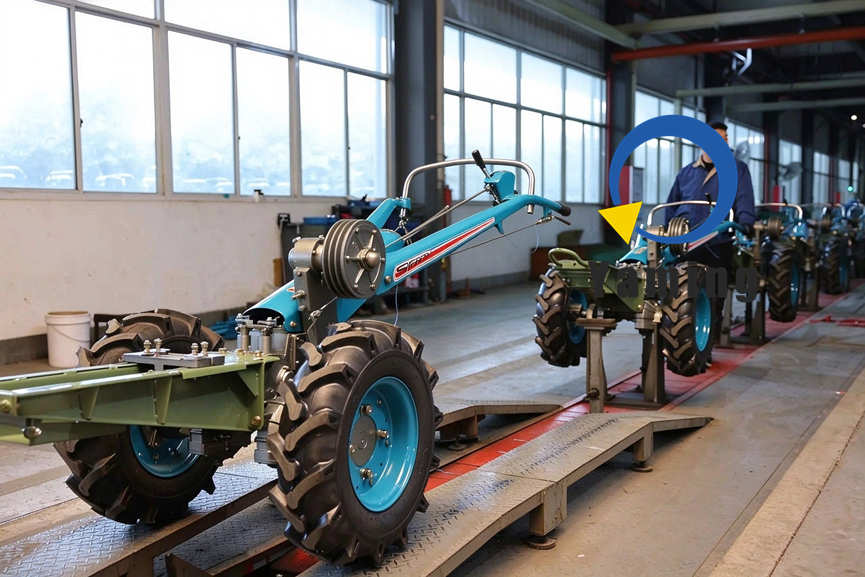
This walking tractor production line uses an in-floor towline conveyor: a chain embedded below the floor tows work trolleys along a ground track. Each trolley carries adjustable clamping fixtures, so the walking tractor frame is locked and positioned once it comes on line. The trolleys move at a set rhythm through frame pre-assembly, gearbox assembly, drive wheel installation, control handle assembly, drivetrain mounting, machine commissioning and final off-line inspection — a complete walking tractor assembly line.
The line is built from the floor trench chain, ground rail, circulating work trolleys, frame clamping fixtures and the drive/tensioning control system. Because the chain sits in a trench below the floor, it leaves the workshop floor clear for movement. Each trolley has a self-locking clamp with adjustable travel, so the frame stays stable with no shifting during assembly, which makes it easier for workers to fit the precise gearbox and control components. Stations are fitted with jib cranes, servo tightening tools and parts turn-tables. A station terminal with a barcode scanner ties each machine to its serial number and records key bolt torques, assembly clearances and control performance values for full traceability. The fixtures are quick to adjust, so the line can run walking tractors of different horsepower in mixed production — suited for new walking tractor workshops or upgrades to existing assembly lines.
The line addresses the common problems of difficult chassis positioning, awkward workpiece handling and missing quality records on critical steps, and catches transmission drag, control failure and loose fasteners before they become defects. The in-floor towline offers strong towing capacity, smooth running and long loop layouts, making it a good fit for heavy, full-machine assembly.
2. Assembly Process
The walking tractor production line uses in-floor towline transport, with work trolleys towed by the embedded chain along a ground track:
- Load and clamp station — the walking tractor frame is lifted onto the trolley, the fixtures clamp and lock it, the operator scans the machine serial number, and the trolley moves to the next station.
- Chassis pre-assembly station — mount the drive wheel brackets and suspension mounting base to complete the chassis base positioning.
- Gearbox fitting station — install the gearbox assembly, connect the transmission structure, torque the critical fasteners with a servo tool, and record the torque data.
- Drive and control mechanism assembly station — fit the wheel set, handlebar frame, and clutch and throttle control cables, and check control travel.
- Drivetrain assembly station — install the diesel engine or electric motor assembly and connect it to the input drive.
- Machine commissioning station (core station) — run the transmission, clutch and steering controls unloaded, and check for transmission noise and control sticking.
- Final inspection station — review overall finish, assembly dimensions and operating performance; the system marks the machine as pass or fail.
- Unclamp and off-line station — acceptable machines are unclamped and lifted off; failed units stay on the trolley for rework and return to the commissioning station; empty trolleys are towed back along the return loop to the load station.
The key advantage of the in-floor towline plus clamping fixture: the underground chain keeps the floor clean of large obstructions, delivers high towing capacity for heavy machine assembly, and the circulating trolleys support mixed production across walking tractors of different horsepower.
3. Customizable Parameters
The walking tractor production line is a heavy towing-type agricultural machinery assembly line. The floor trench chain, rail, trolley bodies, clamping fixtures and inspection modules can all be built to order around the machine’s dimensions, total weight and required cycle time:
- Transport system — embedded long-pitch towing chain below the floor, ground steel rail, circulating work trolleys, variable-frequency drive; line length and number of stations are planned to production capacity, in straight or loop track layouts.
- Trolley clamping fixtures — each trolley carries pneumatic/hydraulic clamps with adjustable travel to suit different frame sizes; the clamps have self-locking protection and controllable clamping force to avoid deforming the frame.
- Electrical and data collection system — station operator terminals, barcode scanners, serial-number binding, and recording of tightening torque and assembly inspection values; process interlock and audible/visual alarms, with data logging for traceability.
- Integrated inspection modules — optional servo tightening units, drivetrain running check fixtures and control mechanism travel verification devices.
- Line safety structure — safety guards, emergency stop interlocks at every station, limit bumpers at both track ends, and overload protection on the chain drive station to prevent the chain from overloading and breaking.
- Model expansion — quick adjustment of clamp travel to run walking tractors of different horsepower plus matching implement chassis in mixed production.