1. Overview
An agricultural tractor is a heavy-duty piece of construction machinery. The complete unit integrates a diesel engine, transmission, drive axles, a hydraulic lifting system, a running chassis, steering, and an electrical control system. Assembly of such a unit is not simply a matter of “getting it running.” Clear factory inspection requirements apply to transmission torque, hydraulic sealing, power output performance, and braking safety — if the transmission torque is out of spec, gears and shafts wear prematurely under heavy working loads; if the hydraulic system is not sealed properly, the lifting and hitch action becomes slow or fails; and if braking performance is not up to standard, it is a direct safety risk on sloped field work. Such defects are often hidden in the workshop and only surface once the machine is working in the field, where rework is expensive and delays field work.
Under a conventional discrete work-station assembly mode, the tractor’s own weight is considerable and moving the unit between stations is difficult, often requiring an overhead crane or dragging. Assembly is fragmented across multiple breaks, information is not continuous between stations, and problems such as hydraulic line leakage, substandard fastener torque, abnormal hydraulic lifting action, and failed braking performance easily slip through during transfer. Consistency is poor, and by the time a defect is found it is difficult to trace back to the station that caused it.
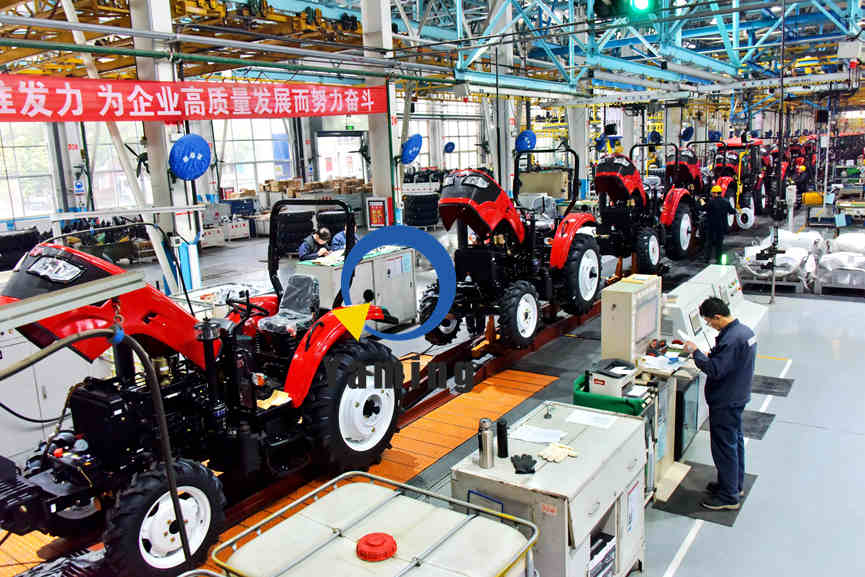
The tractor final assembly line (tractor production line) is the core non-standard heavy-duty equipment for agricultural machine complete assembly. It uses a heavy-duty slat conveyor as the main conveying structure, carrying the tractor chassis and complete unit through the full process from chassis pre-assembly, engine mating, transmission assembly, and hydraulic line connection, through covering-panel installation, complete-unit debugging, power test run, and final-inspection unloading. Compared with track or trolley conveying, a slat conveyor better absorbs the load impact of a heavy complete unit such as a tractor. The unit is aligned to each station while still on the conveyor, so it no longer depends on repeated dragging or crane transfer, the link between stations is more continuous, and assembly fragmentation is clearly reduced.
The tractor production line relies on the heavy-duty slat conveyor to carry the complete tractor. Stations are equipped with jib cranes, torque tools, and quick-connect interfaces for hydraulic testing. The line carries work-station industrial terminals that bind the complete unit’s SN by barcode and capture and store key data — critical bolt tightening torque, hydraulic system pressure, power output parameters, and braking performance — enabling traceability of each unit’s assembly steps. The tractor assembly line supports mixed-line production of wheeled tractors in multiple horsepower ranges, with support bases that adjust quickly to different models. It is widely used in newly built final-assembly workshops for agricultural machinery plants and in retrofitting older tractor lines, addressing the practical problems of difficult handling of heavy units, missed hydraulic and transmission inspection, and long complete-unit performance debugging time. It catches defects early — oil leakage, transmission noise, hydraulic lifting failure, and braking failure — reduces field breakdowns of agricultural machinery, stabilizes assembly takt, and improves on-site management of the plant.
The slat conveyor has another practical value in both load-bearing and takt stability. The conveyor directly carries the complete unit’s weight and assembly impact, and the takt of one station can be decoupled from the others — when one station’s equipment is under maintenance or adjustment, the remaining stations can keep operating, so a single-point fault does not hold up the whole line. This matches the multi-system, multi-inspection, heavy-load nature of tractor assembly.
2. Assembly Process
The tractor slat final-assembly line is laid out by station according to the agricultural machinery manufacturing process, with the slat conveyor carrying the chassis through each step:
- Chassis pre-assembly station: The frame comes on line; the front/rear axles, half shafts, suspension brackets, and braking system are pre-assembled, and the transmission parts are positioned.
- Engine mating station: The diesel engine is lifted onto the frame with lifting equipment, mated to the clutch and transmission, and the drive system is connected; the fixing bolts are tightened to the process torque.
- Hydraulic and line assembly station: The hydraulic pump, distributor, and cylinders are installed, hydraulic oil lines are laid out, and the wiring harness, fuel tank, and steering components are assembled, with control over line fittings.
- Covering-panel assembly station: The hood, seat, instrument panel, fenders, and tire assemblies are installed, completing the external accessory assembly.
- Hydraulic and power debugging station: The core station of this line. Test medium is connected, the engine is started, and the hydraulic lifting, steering, and PTO power take-off functions are tested. System oil pressure is monitored, and leaks and sluggish action are checked; braking performance is verified.
- Complete-unit test run and final inspection station: The unit is run empty and under load. Engine running condition and transmission noise are checked, external appearance is reviewed, and electrical safety is inspected; the system decides pass/fail.
- Unloading and sorting station: Passing units are sent to the painting or packaging area; failing units are reworked on site and return to the complete-unit debugging process after repair.
The hydraulic and power debugging station is the gatekeeping point of this line. Whether the hydraulic lifting, steering, and PTO power take-off functions work properly, and whether braking performance meets standard, determines whether a tractor can be shipped as a qualified agricultural unit. It is therefore arranged after complete assembly and before the test run, validating by actually running the unit on connected test medium, so that hydraulic leakage, sluggish action, and braking failure are caught before the unit enters final inspection.
The heavy-duty slat conveyor has high load capacity and impact resistance, making it suitable for step-by-step assembly and debugging of heavy agricultural machinery such as tractors, in line with the factory inspection specification for agricultural equipment.
3. Customizable Parameters
The tractor final-assembly production line is a heavy-load agricultural machinery assembly line. The conveying structure, tooling, and test modules can all be customized to the tractor’s horsepower, complete-unit weight, and production takt:
- Conveying main body: Heavy-duty slat conveyor carrying the tractor chassis, with variable-frequency speed control; line length and number of stations are designed according to production takt, in either straight or U-shaped layouts.
- Load-bearing tooling base: A customized adjustable support tooling that holds the frame and adapts to wheeled tractors of different wheelbases and horsepower ranges, with optional locating blocks.
- Electrical control and data system: Work-station operating terminals and barcode scanners bind the complete-unit serial number and capture tightening torque, hydraulic pressure, and test-run parameters; process error-proofing with audible and visual alarms.
- Integrated test modules: Optional integration of a servo tightening system, hydraulic pressure test unit, braking performance test module, and PTO power output data acquisition device.
- Line structure: Heavy carbon-steel welded and powder-coated frame; equipped with safety guardrails, emergency-stop interlocks, and station jib lifting cranes, with adjustable feet to suit the workshop floor.
- Model compatibility and expansion: Reserved stations for robotic engine mating, automatic sealant application, and nameplate marking; compatible with mixed-line assembly of wheeled tractors and orchard tractors.
The tractor final-assembly line is a heavy-load agricultural machinery assembly line. Its design focuses on slat-conveyor load reliability, critical torque control, and hydraulic and transmission system debugging, helping agricultural machinery manufacturers achieve large-scale, standardized assembly and performance testing of complete tractors.