1. Overview
The chassis of a small and medium mini wheel loader is structurally complex. It integrates the running axle, hydraulic multi-way valve, cylinders, steering and braking system, and the powertrain and electrical assembly, and the complete unit is fairly heavy. Assembly requires reliable positioning and clamping to prevent shifting and rocking, so that workers can install piping and fasteners from multiple angles. This is not a case of simply “getting it running.” Whether the drive connection is reliable, whether the hydraulic system is sealed, and whether braking meets standard directly determine whether the loader can deliver stable power and operate safely under working conditions — hydraulic leakage causes weak lifting and sluggish action, and braking failure is a direct safety risk when loading material on sloped ground. Such defects are often hidden in the workshop and only surface once the machine is working on site.
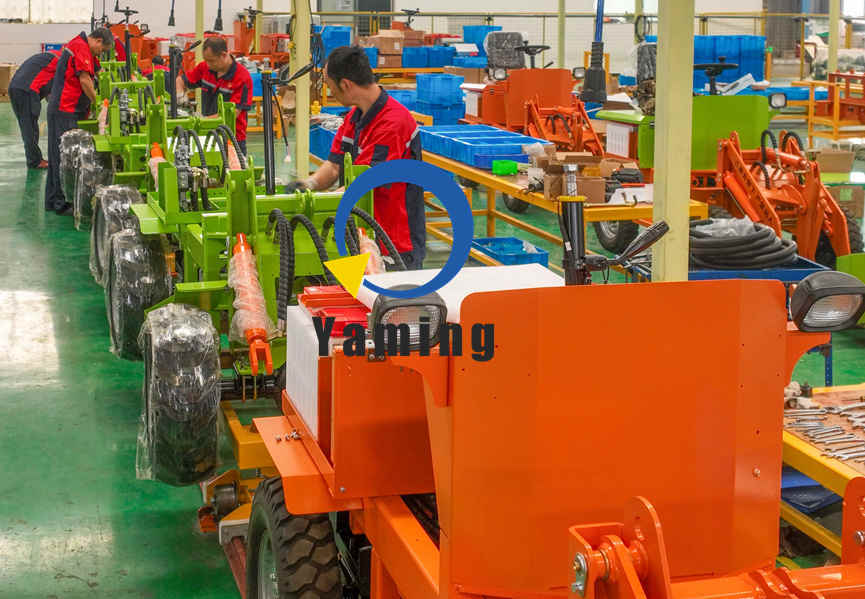
Under a conventional fixed work-station assembly mode, the workpiece is frequently lifted and moved, safety risk is high, assembly consistency is poor, and torque and hydraulic test data cannot be traced continuously. By the time a defect is found it is difficult to trace back to the station that caused it. The track trolley assembly line (rail guided trolley mini wheel loader production line) uses ground steel rails and circulating trolleys as the conveying system. Each trolley carries an adjustable clamping fixture. Once the loader chassis comes on line it is clamped and fixed, and the trolley conveys it in a pulse-motion cycle along the rail through the full process: chassis pre-assembly, powertrain mating, hydraulic line assembly, steering and braking assembly, electrical installation, complete-unit debugging, loaded test run, and final-inspection unloading. This wheel loader production line is the core equipment for complete assembly of small and medium wheel loaders.
The mini wheel loader assembly line consists of steel rails, circulating trolleys, chassis clamping fixtures, and the drive control system. Each trolley carries a locating and clamping mechanism whose clamping stroke adjusts to different frame widths and locks after clamping, so the complete unit does not shift or rock during assembly. This is the core difference between the track trolley solution and roller conveyors or power-and-free conveyors — those systems can only carry and convey, but cannot hold a heavy complete unit reliably clamped throughout assembly. Stations are equipped with jib cranes, servo tightening tools, and quick-connect interfaces for hydraulic testing. Work-station industrial terminals with barcode modules bind the complete unit’s SN and capture and store key parameters — critical bolt torque, hydraulic pressure, and braking performance — enabling traceability of each loader’s assembly steps. Releasing the clamping fixture enables quick changeover, supporting mixed production of multiple models of small and medium wheel loaders. It is widely used in newly built final-assembly workshops for loader plants and in retrofitting older assembly workshops. It solves the practical problems of difficult handling of heavy complete units, unstable assembly positioning, and missed hydraulic leakage inspection, catches defects early — line oil leakage, substandard fastener torque, and braking failure — improves operating reliability, stabilizes assembly takt, and improves on-site management. The pulse-motion trolley conveying decouples station takt, so a single-station fault does not hold up the whole line.
2. Assembly Process
The track trolley assembly line is laid out by station according to the loader manufacturing process, with trolleys circulating in a pulse-motion cycle along the ground steel rails:
- Loading and clamping station: The loader chassis is lifted onto the trolley tooling, the fixture clamps and locks, the complete-unit SN is scanned in, and the trolley moves to the next station.
- Chassis pre-assembly station: The front and rear axles, brake brackets, and suspension components are installed, completing the basic chassis assembly.
- Powertrain mating station: The powertrain is lifted on and connected to the drive mechanism; critical bolts are tightened with the servo tool, and the system records the torque data.
- Hydraulic system assembly station: The hydraulic pump, multi-way valve, and lift cylinders are installed, high-pressure hydraulic lines are laid, line clamps are fixed, and joint sealing is controlled.
- Steering and electrical assembly station: The steering tie rod, controller, wiring harness, battery, operating levers, and lights are assembled.
- Complete-unit hydraulic debugging station (core station): Test medium is connected, the power unit is started, and cylinder action, steering, and braking are tested. System pressure is monitored, and leakage and sluggish action are checked.
- Complete-unit test run and final inspection station: The unit is run empty; driving, hydraulic, braking, and electrical functions are rechecked, appearance is inspected, and the system decides pass/fail.
- Unclamping and unloading station: For passing units, the trolley fixture is released and the unit is lifted off or driven off the line; failing units remain on the trolley for on-site rework and return to the debugging station after repair; empty trolleys return along the rail to the loading station.
The complete-unit hydraulic debugging station is the gatekeeping point of this line. Whether cylinder action, steering, and braking work properly, and whether system pressure is stable, determines whether a loader can be shipped as a qualified complete unit. It is therefore arranged after complete assembly and before the test run, validating by actually running the unit on connected test medium, so that hydraulic leakage, sluggish action, and braking failure are caught before the unit enters final inspection.
The core advantage of the track trolley and clamping fixture: the workpiece is held clamped throughout assembly, so it does not shift or rock, making heavy-part assembly easier; the trolley is reused, supporting multi-model changeover production of loaders.
3. Customizable Parameters
The track trolley assembly line is a heavy-load pulse-motion assembly line. The steel rails, trolleys, clamping tooling, and measurement and control modules can all be customized to the loader’s external dimensions, complete-unit weight, and production takt:
- Conveying main body: Heavy ground steel rails and circulating trolleys with variable-frequency pulse-motion drive; line length and number of stations are designed according to production takt, in straight or loop rail layouts.
- Trolley clamping tooling: Each trolley carries a pneumatic/hydraulic clamping fixture with adjustable clamping stroke to fit different frame widths; the fixture has self-locking anti-loosening protection and adjustable clamping force to prevent frame deformation.
- Electrical control and data system: Work-station operating terminals and barcode scanners bind the complete-unit serial number and capture tightening torque, hydraulic pressure, and test-run parameters; process error-proofing with audible and visual alarms.
- Integrated test modules: Optional integration of a servo tightening unit, hydraulic pressure test unit, braking performance test module, and electrical circuit test device.
- Line safety structure: The whole line is equipped with safety guardrails and station emergency-stop interlocks; the rail has limiting anti-collision blocks; trolleys have overload protection to prevent accidental fixture release.
- Model compatibility and expansion: Fast adjustment of the fixture clamping stroke supports mixed assembly of orchard wheel loaders, self-propelled tilling machines, and small multifunctional loaders.
The track trolley assembly line is a dedicated pulse-motion assembly line for complete assembly of small and medium wheel loaders. Its design focuses on trolley travel stability, reliable chassis clamping tooling, and in-line hydraulic and transmission system testing, helping loader manufacturers achieve large-scale, standardized complete assembly and factory performance debugging across multiple models.