I. Overview
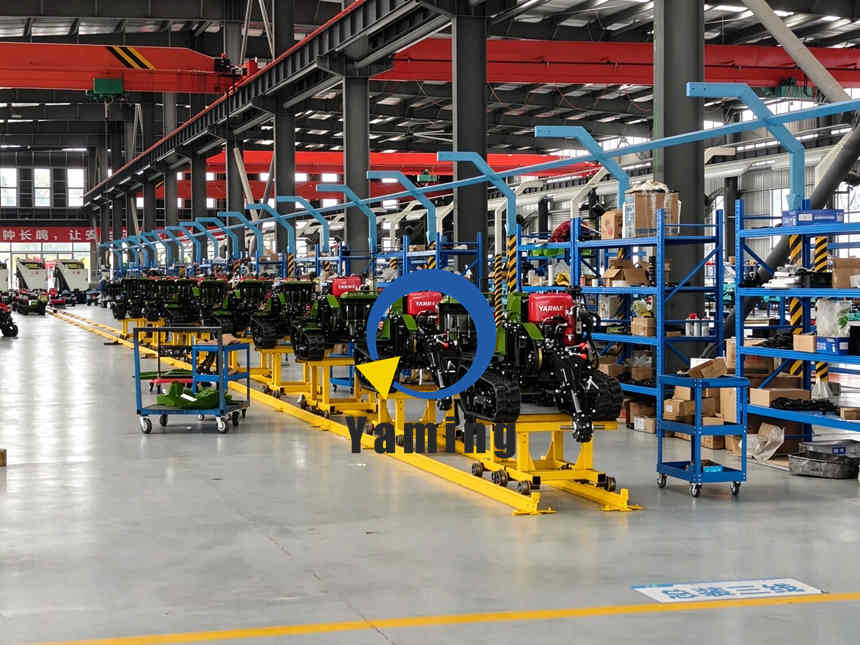
The mini tiller (tracked mini tiller / power tiller) is a small mountain agricultural machine that relies on a crawler running gear for low ground contact pressure, suitable for slopes, orchards, greenhouses and paddy fields, and capable of tilling, ditching, weeding and backfilling. A complete unit consists of a diesel engine, gearbox, crawler chassis, steering mechanism, tilling tools and a control system. The compact structure makes chassis assembly, track tension adjustment and powertrain docking relatively demanding. Traditional fixed-station production makes whole-machine transfer difficult, results in inconsistent assembly quality, and leads to high changeover costs in multi-model mixed production. The mini tiller production line adopts a ground rail plus mobile fixture trolley conveying structure. The fixture trolley carries the mini tiller chassis and moves step by step along the rail at a set takt time. Equipped with station jib cranes and material racks, the line completes the full sequence of chassis pre-assembly, powertrain assembly, transmission fitting, track installation, control mechanism assembly, machine adjustment, performance inspection and off-line operations.
The complete mini tiller assembly line consists of ground rails, mobile fixture trolleys, drive and positioning mechanisms, station lifting aids, a variable-frequency electrical control system, and torque acquisition and quality traceability modules. The rail trolley offers high load capacity and a built-in positioning and locking mechanism, so the machine can be locked in place during assembly to prevent swaying, making it easy for operators to perform engine hoisting, track fitting and pipe connection. Each station is equipped with torque wrenches, test-run fixtures and barcode scanners that bind the unit SN number and record key bolt torque, no-load running and track travel performance parameters, forming complete process data and traceability records for every single machine. The positioning supports on the fixture trolleys can be quickly replaced, allowing mixed production of mini tillers with different horsepower and track widths. With fixed work sequences and clear operation steps, the line reduces dependence on individual operator skill, and is suitable for small and medium agricultural machinery manufacturers building new final assembly workshops or upgrading existing lines. It effectively solves the problems of difficult chassis assembly, difficulty in standardizing track tension, and long model changeover cycles, reduces defects such as transmission noise, track deviation and loose bolts, stabilizes the takt time, and ensures consistent product quality. The rail trolley provides station buffering, so rework at a single station does not stop the entire line, ensuring production continuity.
II. Assembly Process
On the mini tiller production line, the mini tiller chassis is fixed on the fixture trolley and moves along the ground rail station by station:
- Chassis loading station: the chassis is hoisted onto the positioning support of the fixture trolley, the trolley is locked, the SN number is scanned and recorded, and the trolley enters the line.
- Powertrain assembly station: a jib crane hoists the engine, the engine is docked with the gearbox, and the fuel lines and muffler are installed.
- Transmission and running gear assembly station: the gearbox housing and clutch-steering components are fitted, the track assembly is installed, and track tension is adjusted.
- Control mechanism assembly station: the handlebar, throttle, clutch and steering control rods are installed, and the protective housing is fitted.
- Tilling component assembly station: tilling blades, trenchers and other supporting implements are installed.
- Filling and test-run station: engine oil and coolant are filled, and a no-load test run checks engine condition, track travel and steering action, identifying deviation and noise issues.
- Final inspection station: key bolt torque, appearance and travel and tilling performance are rechecked, and the system determines pass / fail.
- Off-line station: qualified machines are packed and removed; defective units are reworked on site and re-inspected; empty trolleys return automatically along the rail to the loading station.
Key features of the rail trolley conveying solution: high positioning accuracy, stable trolley load capacity, suitable for tracked small agricultural machine assembly; easy fixture changeover, adapted to mixed production of multiple mini tiller models.
III. Customizable Parameters
The mini tiller production line is a complete-machine assembly line for small tracked agricultural machinery. The ground rails, fixture trolleys, positioning supports and inspection modules can be customized according to machine dimensions, total weight and takt time:
- Conveying body: ground rail plus mobile fixture trolleys with variable-frequency drive; total line length and number of stations are designed according to capacity planning, with loop return layout available.
- Trolley positioning supports: adjustable positioning supports on the trolleys fit different mini tiller chassis specifications and allow quick model changeover.
- Data collection system: station terminals and barcode scanning modules record tightening torque and machine test-run parameters; process error-proofing with audible and visual alarms; data can be integrated with the customer’s existing management system.
- Integrated inspection modules: torque data acquisition system, track travel performance test fixture and no-load power test unit can be integrated.
- Safety structure: safety guardrails and station emergency-stop interlocks along the whole line; trolleys are equipped with limit, buffering and locking mechanisms to ensure safe assembly operations.
- Model extension: quick-change trolley fixtures allow mixed assembly of mini tillers, tracked orchard management machines and similar small tracked agricultural machines.